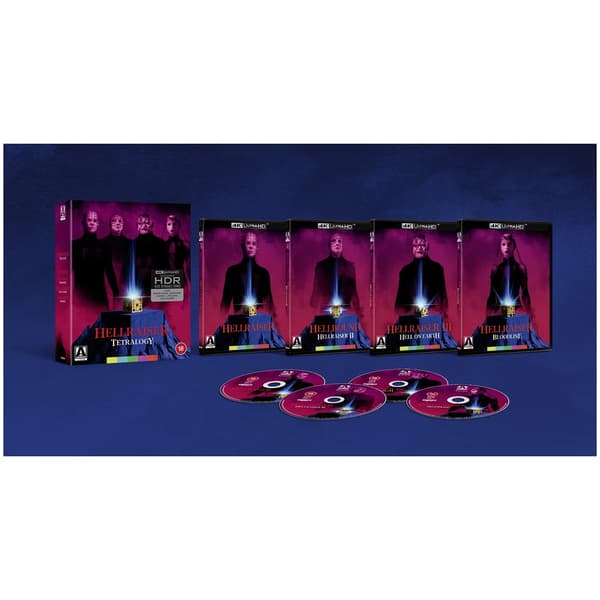
Hellraiser - Tetralogy (1987-1996) | 4 Movie Collection 4K UHD (import)
Dubbelkollat idag
Jämför 1 butik
- CDON, 799 kr, frakt enligt butiken. Till butik (öppnas i ny flik)
I lagerFrakt: se butikenDubbelkollad 13:15
799 kr
Lägst

Priser från butikernas flöden kan ha ändrats: det är priset hos butiken som gäller, så kontrollera det innan du handlar.
Om produkten
Detta är en importfilm
Läs merLäs mindre
Ofta har de inte svensk text. Kontrollera detta om textningen är viktig. Hellraiser (1987) Directed by Clive Barker from his novella The Hellbound Heart, Hellraiser follows a family ensnared by a puzzle box that opens a gateway to a realm of sadomasochistic beings known as the Cenobites. The film blends supernatural horror with themes of desire, transgression, and bodily transformation. Its practical effects, stark imagery, and the introduction of Pinhead established it as a landmark of 1980s dark fantasy horror. Hellbound: Hellraiser II (1988) Hellbound, directed by Tony Randel, continues the story as a young survivor is drawn into the labyrinthine world ruled by Leviathan while confronting the origins of the Cenobites. The film expands Barkers mythology through psychological surrealism, medical horror, and interdimensional landscape design. Its emphasis on trauma, memory, and corrupted desire gives the sequel a more operatic, expansive tone. Hellraiser III: Hell on Earth (1992) Directed by Anthony Hickox, Hell on Earth relocates the franchise to an urban setting where Pinhead manifests independently and spreads chaos through a series of violent transformations. The film blends early-1990s supernatural spectacle with themes of identity fragmentation and spiritual imbalance. Its shift toward action-inflected horror marks a stylistic departure from the earlier, more intimate entries. Hellraiser: Bloodline (1996) Bloodline, directed by Kevin Yagher (credited as Alan Smithee), traces the history of the puzzle box across multiple eras from its 18th-century creation to a future attempt to end Pinheads influence permanently. The film mixes gothic tragedy, science fiction, and franchise lore, emphasizing generational responsibility and the cyclical nature of temptation. Its multi-period narrative offers an amb